In 2015, I spent time at Sandor Katz's home in Tennessee as part of a fermentation residency. One day, we drove out to Jeff Poppen's Long Hungry Creek Farm in Red Boiling Springs to pick turnips. Jeff is better known in the area as "The Barefoot Farmer"—and yes, when we arrived, he was barefoot, with maybe the longest beard I've ever been that close to.
Jeff farms barefoot as a deliberate practice. He told us that when he wears shoes, he's physically exhausted by mid-afternoon, but barefoot, he can keep going as long as he likes. Direct contact with the soil, is commonly known as "earthing" or "grounding", working with the theory that the earth's surface carries a negative electrical charge, and when you make direct contact (no rubber soles acting as insulators), your body absorbs electrons that help neutralize inflammation and boost energy. We plucked from those fields - it was cold and so we all wore shoes however much I wanted to take mine off.
And the turnips! Gosh they were massive, almost cartoonish things, practically leaping out of the ground when you pulled them. It looked quite cartoonlike to me to walk those fields with the turnips just sitting there - half out - as know they'd been placed there for effect. Maybe I haven't been in enough turnip fields. We filled the back of a ute and headed back to Sandor's place to process them into sauerruben.
I'll be honest: the processing day was not my favourite as I was already deep into large-scale fermentation work back home, and spending hours grating what felt like a mountain of turnips wasn't exactly my idea of an educational activity. It did give us that sense of community - organising ourselves and sharing the workload and many others in the residency hadn't done such a large amount before. At The Ferm we would likely do 20 times that in a day - but with commercial graters etc. Anyway - it was the picking of them and being on that farm that comes to mind as quite magic.
Sauerruben is traditional in parts of Germany, Austria, and Eastern Europe, but you almost never see it on Australian shelves, I'm not sure why... it's very simple: just turnips, salt, and time. The result is tangy, crunchy, earthy, and incredibly versatile, without the cabbage sweetness, instead more root vegetable depth.
[For more about Jeff Poppen and the philosophy of barefoot farming, read his books! Check out his website HERE. If you're ever over there he sometimes offers spaces to camp via HipCamp and there are many beautiful spots to camp in Tennessee!
Ingredients
Basic Sauerruben
1kg turnips (white, purple-top, or a mix)
20g sea salt (2% of the turnip weight)
Equipment:
Large bowl
Grater or food processor
1-litre jar or fermentation crock
Weight to keep turnips submerged
Directions
Prepare the turnips:Scrub the turnips well. You can peel them if you like, but it's not necessary—the skins add colour and nutrients. If the turnips are very large or woody, trim away any tough bits.
Grate:Using a box grater or food processor, grate the turnips into a large bowl. You want medium-coarse shreds—not too fine (they'll turn mushy), not too chunky (they won't release enough liquid).
Salt and massage:Sprinkle the salt over the grated turnips and massage firmly with your hands for 5-10 minutes. The turnips will start releasing liquid and wilting. You want to see a pool of brine forming at the bottom of the bowl.
Pack into jar:Transfer the turnips and all their liquid into a clean jar or crock, pressing down firmly as you go to eliminate air pockets. The turnips should be submerged under their own brine. If they're not quite covered, make a small amount of extra brine (1 tablespoon salt dissolved in 250ml water) and add just enough to cover.
Weight it down:Place a weight on top of the turnips to keep them submerged. This could be a clean glass weight, a small jar filled with water, or a ziplock bag filled with brine.
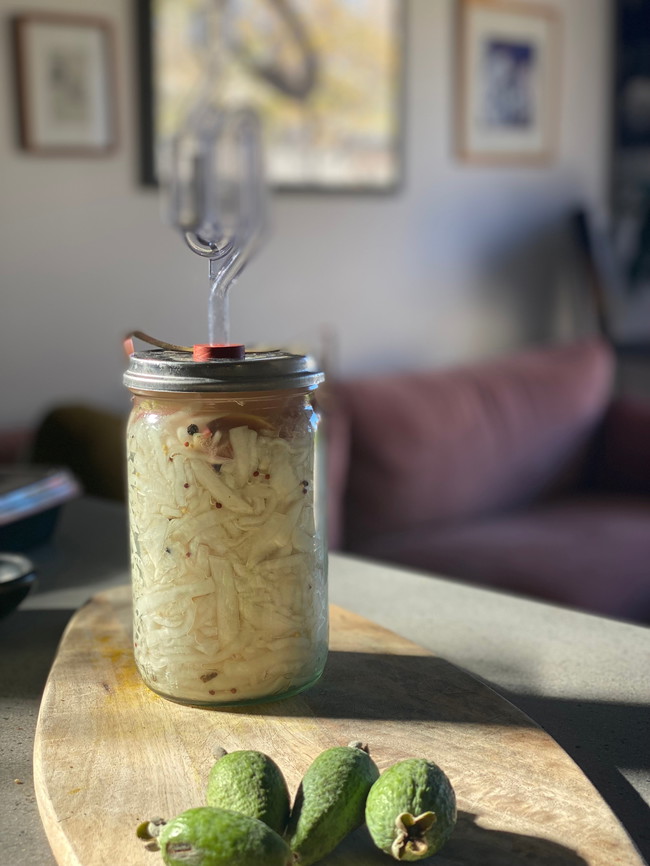
Cover:Cover the jar with a cloth secured with a rubber band, or use an airlock lid if you have one. You want gas to escape but don't want dust or insects getting in.
Ferment:Leave at room temperature (18-22°C is ideal) for 5-10 days. Check daily. You should see bubbles forming within 24-48 hours. The brine may become cloudy—this is normal.
Taste:Start tasting after 5 days. When it's pleasantly tangy and the turnips have softened slightly but still have crunch, it's ready. In warmer weather, this might be 5 days. In cooler weather, it could take 10 days or more.
Store:Transfer to the fridge, where it will keep for months. The flavour will continue to develop and mellow over time.
How to Use Sauerruben:
Serve as a side dish with sausages, pork, or roasted meats
Add to grain bowls for crunch and tang
Mix into potato salad instead of pickles
Serve alongside cheese and bread
Chop finely and stir into salad dressings or mayo-based sauces
Pile onto sandwiches or burgers
Stir through mashed potatoes or root vegetable mash
Serve with smoked fish
Recipe Note
Turnip choice: Any turnip variety works. Purple-top turnips are most common, but small white Japanese turnips are lovely too. Avoid anything woody or overgrown—they'll be bitter.
Texture: Turnips release less liquid than cabbage, so you may need to add a bit of extra brine. Don't skip the massaging step—it's essential for releasing liquid.
Mould watch: White kahm yeast (a thin white film) is harmless—skim it off. Pink, black, or fuzzy mould means something went wrong; discard and start again.
Smell: Fermenting turnips can smell quite strong—earthy, funky, almost sulphurous at first. This is normal. The smell mellows as fermentation progresses.
Salt ratio: 2% is a safe, reliable ratio. You can go as low as 1.5% for a faster, less salty ferment, or up to 2.5% for a slower, longer ferment.
Variations (Optional)
If you want to add herbs or aromatics, here are some traditional and non-traditional options:
Traditional German-style:
Add 1 teaspoon caraway seeds
Add 2-3 juniper berries, crushed
Earthy, slightly medicinal, very traditional
With Garlic and Dill:
Add 3-4 cloves garlic, thinly sliced
Add a small bunch of fresh dill, roughly chopped
Bright, herbal, Eastern European
With Ginger:
Add 20g fresh ginger, julienned or grated
Warming, slightly spicy, unexpected
With Beetroot:
Add 200g grated beetroot to the turnip mix
Vibrant pink colour, earthy sweetness
With Apple:
Add 1 tart apple, grated
Subtle sweetness, more complex flavour
With Horseradish:
Add 2 tablespoons freshly grated horseradish
Sharp, sinus-clearing, excellent with rich meats
How to Use Sauerruben:
Serve as a side dish with sausages, pork, or roasted meats
Add to grain bowls for crunch and tang
Mix into potato salad instead of pickles
Serve alongside cheese and bread
Chop finely and stir into salad dressings or mayo-based sauces
Pile onto sandwiches or burgers
Stir through mashed potatoes or root vegetable mash
Serve with smoked fish
Why This Ferment Matters
Turnips are cheap, abundant in autumn and winter, and often overlooked. Fermenting them transforms a humble root vegetable into something tangy, crunchy, and utterly compelling.
Sauerruben embodies The Fermentary philosophyl; it relies on the invisible, it's not fancy. It doesn't require special equipment or rare ingredients. It just requires turnips preferable from great soil, and the time and willingness to let them do their thing.
If you've never fermented turnips before, start here. You'll understand why this simple ferment has sustained people through long European winters for centuries, and why it deserves a place on Australian tables too.
I had some turnips sitting in my fridge, from a local farm here and a few of them were getting wrinkly so I decided to make Sauerrüben with them. After peeling, trimming and grating them, I had 370 g of shredded turnip. I added 12 g salt but it wasn’t producing brine. I added 4g salt and got nice brine. Started it yesterday. I have made Sauerkraut a few times before but not this, so I am excited to try it.
El Salvador's answer to sauerkraut - a bright, crunchy fermented slaw that's the perfect foil to rich pupusas and grilled meats. This version uses homemade pineapple vinegar (see recipe) for a subtle tropical sweetness which balances the spice.
White Kimchi with Ginger and Jujubes. Jujubes have been used in traditional Korean medicine for centuries to calm the spirit, build blood, and support women through life transitions. Perfect if you're navigating perimenopause or menopause and dealing with hot flashes, disrupted sleep, or just need something cooling and restorative. Or maybe you just want something different.





Comments